MTD for Income Tax from April 2026: what sole traders need to do
The thresholds, the dates, the quarterly updates and the first-year soft landing on penalties, in one page a self-employed tradesperson can act on.
Making Tax Digital for Income Tax replaces the once-a-year Self Assessment with quarterly updates sent from software, plus a final declaration. It starts in April 2026 for sole traders and landlords with qualifying income over £50,000, and widens over the following two years.
This post is the plain version: who is in and when, what a quarterly update actually is, how the first year's penalties work, and what to do about it now. It is not tax advice; your accountant should confirm your own position.
Who MTD for Income Tax applies to, and when
The test is your qualifying income: your gross income from self-employment and from property, added together, before expenses. It is measured from your tax return for the year two years before the start date, so the April 2026 cohort is decided by the 2024 to 2025 return.
The phased thresholds
| From | Qualifying income over | Decided by tax return for |
|---|---|---|
| 6 April 2026 | £50,000 | 2024 to 2025 |
| 6 April 2027 | £30,000 | 2025 to 2026 |
| 6 April 2028 | £20,000 | 2026 to 2027 |
A window cleaner turning over £55,000 with £15,000 of costs is in from April 2026, because the threshold is gross. A gardener on £28,000 is not in until April 2028, and only if the £20,000 threshold survives unchanged. Below £20,000 there is currently no date.
What changes: quarterly updates and a final declaration
Under MTD for Income Tax you keep digital records of business income and expenses, and every quarter your software sends HMRC a summary of them. The quarters follow the tax year, so the first update covers 6 April to 5 July and is due by 7 August. These are totals, not a tax calculation; there is no payment with a quarterly update.
After the fourth quarter you make a final declaration, which is where accounting adjustments, allowances and other income go in and the tax bill is worked out. In practice the quarterly updates are the new discipline, and the final declaration is Self Assessment by another name. The mechanics are close to what VAT-registered businesses already do, which our plain-English guide to MTD for VAT explains.
The soft landing on penalties
HMRC's late-submission penalties are points-based: each late submission earns a point, and a threshold of points triggers a fine. For MTD for Income Tax, HMRC has said that businesses mandated from April 2026 will not receive late-submission penalty points for quarterly updates during their first 12 months. The final declaration and paying the tax on time are not covered by the soft landing.
Treat the year as practice, not as optional. Four quarterly updates in a row is a habit, and the habit is the hard part.
What to do this year
The businesses that find MTD easy are the ones whose records were already digital. If every invoice, payment and receipt is in an app, a quarterly update is a report your accountant runs. If they are in a diary and a shoebox, the quarter is a bad week.
So the preparation is mostly about the records. Send invoices from software rather than a pad. Record cash on the phone. Photograph receipts on the day, which receipts in the van walks through. Pick an accounting package that HMRC recognises for MTD for Income Tax, or agree with your accountant that they will file the updates from your records; Xero, QuickBooks or FreeAgent helps with the choice.
Where TradeYoke fits, and where it does not
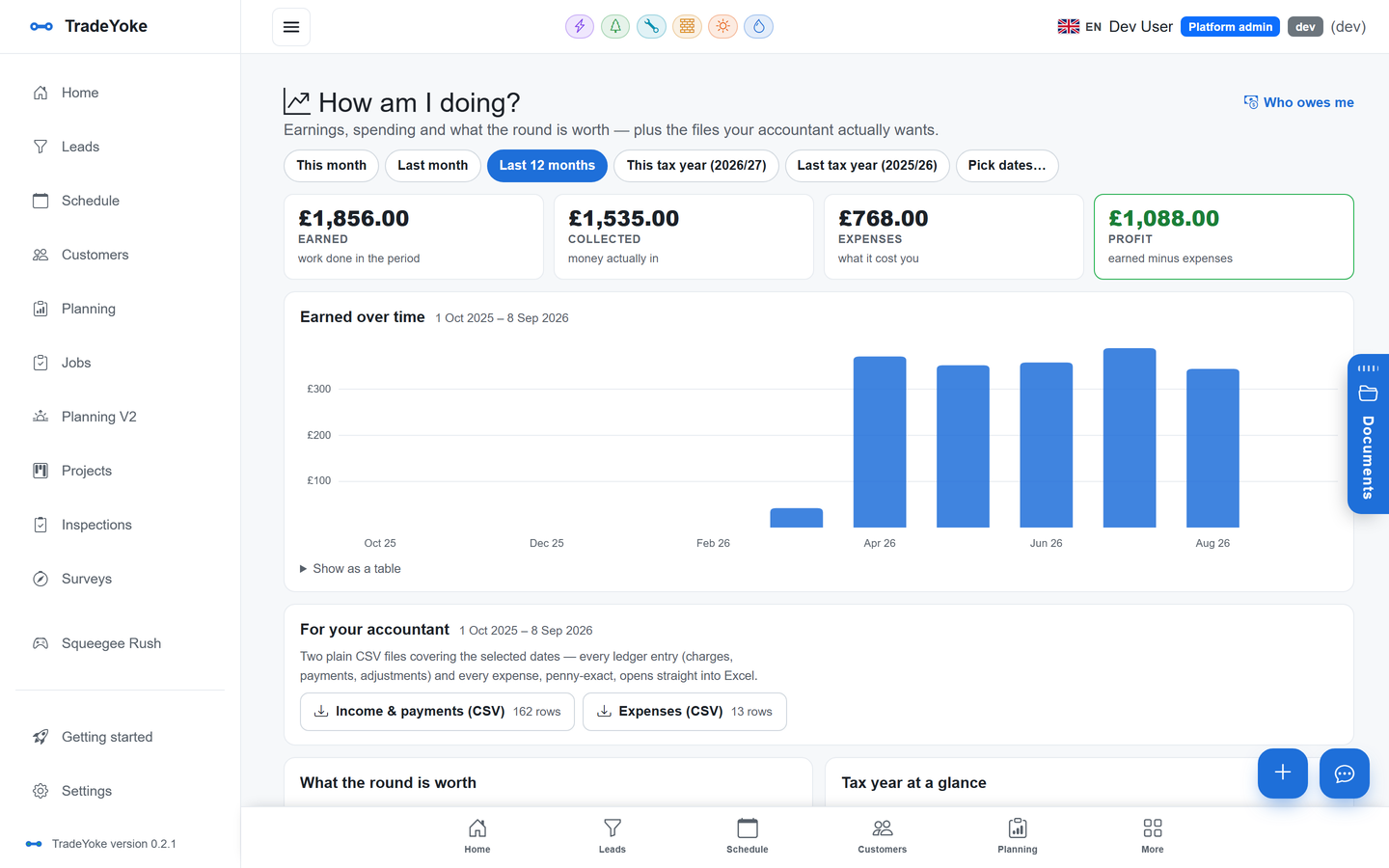
TradeYoke does not send MTD for Income Tax quarterly updates to HMRC today. What it does is keep the records those updates are built from: numbered invoices, payments settled against them, expenses with receipt images and VAT, mileage from the day's stops, and profit by period. Two accountant CSVs, one for income and payments and one for expenses, cover a quarter in one export.
If you use the bookkeeping sync, invoices and payments push to Xero, QuickBooks or FreeAgent with read-back verification, and those packages are where the quarterly update is filed from. The platform overview shows how the ledger, reports and sync fit together, and the pricing page shows which plan includes the sync.
Quarterly updates are not a new job. They are the old job done every three months instead of once in January.
TradeYoke
Before April 2026
- Check your 2024 to 2025 gross incomeSelf-employment plus property. Over £50,000 means April 2026.
- Get every invoice into softwareSent from the app, numbered, with the payment recorded against it.
- Photograph receipts on the daySupplier, total and VAT read for you; attached to a job or vehicle.
- Agree who files the updatesYour accountant, or an MTD-recognised accounting package fed by the sync.
- Run a practice quarterExport the accountant CSVs for one quarter and see how long it takes.
Questions people ask
When does MTD for Income Tax start for sole traders?
6 April 2026 for sole traders and landlords with qualifying income over £50,000, then 6 April 2027 for over £30,000 and 6 April 2028 for over £20,000. Qualifying income is gross self-employment and property income combined, based on the tax return from two years earlier.
What is a quarterly update?
A summary of your business income and expenses for the quarter, sent to HMRC from software. Quarters follow the tax year and each update is due a month and a week after the quarter ends. It is not a tax calculation and no payment is due with it; the tax is worked out in the final declaration after the year ends.
Will I be fined if I miss a quarterly update in the first year?
HMRC has said the April 2026 cohort will not receive late-submission penalty points for quarterly updates during their first 12 months. The final declaration and the tax payment deadlines still apply as normal.
Does TradeYoke file MTD for Income Tax updates?
No. TradeYoke keeps the digital records and exports the accountant CSVs, and its bookkeeping sync pushes invoices and payments to Xero, QuickBooks or FreeAgent. The quarterly update is filed from your accounting package or by your accountant. TradeYoke does file MTD for VAT returns.
Every trade on the platform keeps the same records, whether you run a plumbing and gas business or one of the other supported trades.
Get the records digital before the quarter arrives
Start the free trial, import your customers, and run a practice quarter's export.