Keeping a lone-working tradesperson safe: what actually helps
A scaffolder on their own on a roof, an electrician alone in a plant room, a solar installer working a rural site — lone working is normal in these trades. Here's what genuinely reduces the risk, and how TradeYoke gives the office real visibility without a box wired into the van.
What "lone working" risk actually means for a trade business
Quick answer: lone working means nobody else is there to help if something goes wrong — a fall, an electric shock, a confined space, or simply a medical event — and for scaffolders, electricians and solar installers working roofs, plant rooms and rural sites on their own, that's not the exception, it's most of the working week.
The Health and Safety Executive is clear that working alone isn't against the law, but the employer still has to assess and control the risk it creates — the same duty as any other hazard, just with nobody standing next to the worker to notice if it goes wrong. For a scaffolder erecting a lift on their own, an electrician isolating a circuit in an empty plant room, or a solar installer on a rural roof with no phone signal, the risk isn't a dramatic one-off event; it's the ordinary risks of the job, made worse by the fact that help could be hours away rather than minutes.
What actually reduces the risk, TradeYoke or not
Quick answer: a written risk assessment for the specific job, a check-in routine with a named person who notices if it's missed, and visibility of where the worker actually is — those three things are what every HSE-aligned lone-working guide comes back to.
What genuinely helps a lone worker
- Assess the job before it starts, not afterA five-minute lone-working risk assessment for a specific site catches the things a generic policy misses — access, signal, the nearest help.
- Give someone visibility of where you areSomeone in the office (or another team member) knowing roughly where you are and when you're due back turns a silent no-show into a noticed one.
- Have a named person who'd noticeA check-in routine only works if someone is actually responsible for chasing a missed one — 'someone would probably notice' is not a plan.
- Use a certified alarm device for genuinely high-risk workFor confined spaces or high-fall-risk work, a monitored BS 8484 lone-worker device with a 24/7 response centre is a different, more serious tool than general visibility — the two aren't interchangeable.
- Keep the paperworkA dated risk assessment and a record of who was where is what you'd want to be able to show if something did go wrong.
What the market offers today, and where it splits in two
Quick answer: the market splits into dedicated, monitored lone-worker alarm services (SoloProtect, Peoplesafe) built for genuinely high-risk roles, and general trade job-management software (Jobber, Tradify, ServiceM8) whose GPS tracking is built for dispatch, not framed as a safety feature at all.
Dedicated lone-worker providers like SoloProtect and Peoplesafe sell a serious, purpose-built product: a monitored personal alarm, often BS 8484 certified, backed by a 24/7 response centre that can raise an actual emergency response. That's the right tool for high-risk lone work and TradeYoke doesn't claim to replace it. Separately, general trade software offers GPS tracking too — Jobber's waypoint tracking and Tradify's staff map, for instance — but it's built and marketed for dispatch and route efficiency, not as a safety measure, and it lives in a system that has nothing to do with the certificate or risk-assessment paperwork the job actually needs. Neither camp gives a small trade team the specific thing most of them actually want: the office being able to glance at a map and know where the lone worker on today's roof job is, in the same account as the job itself.
How TradeYoke helps: visibility in the same account as the job
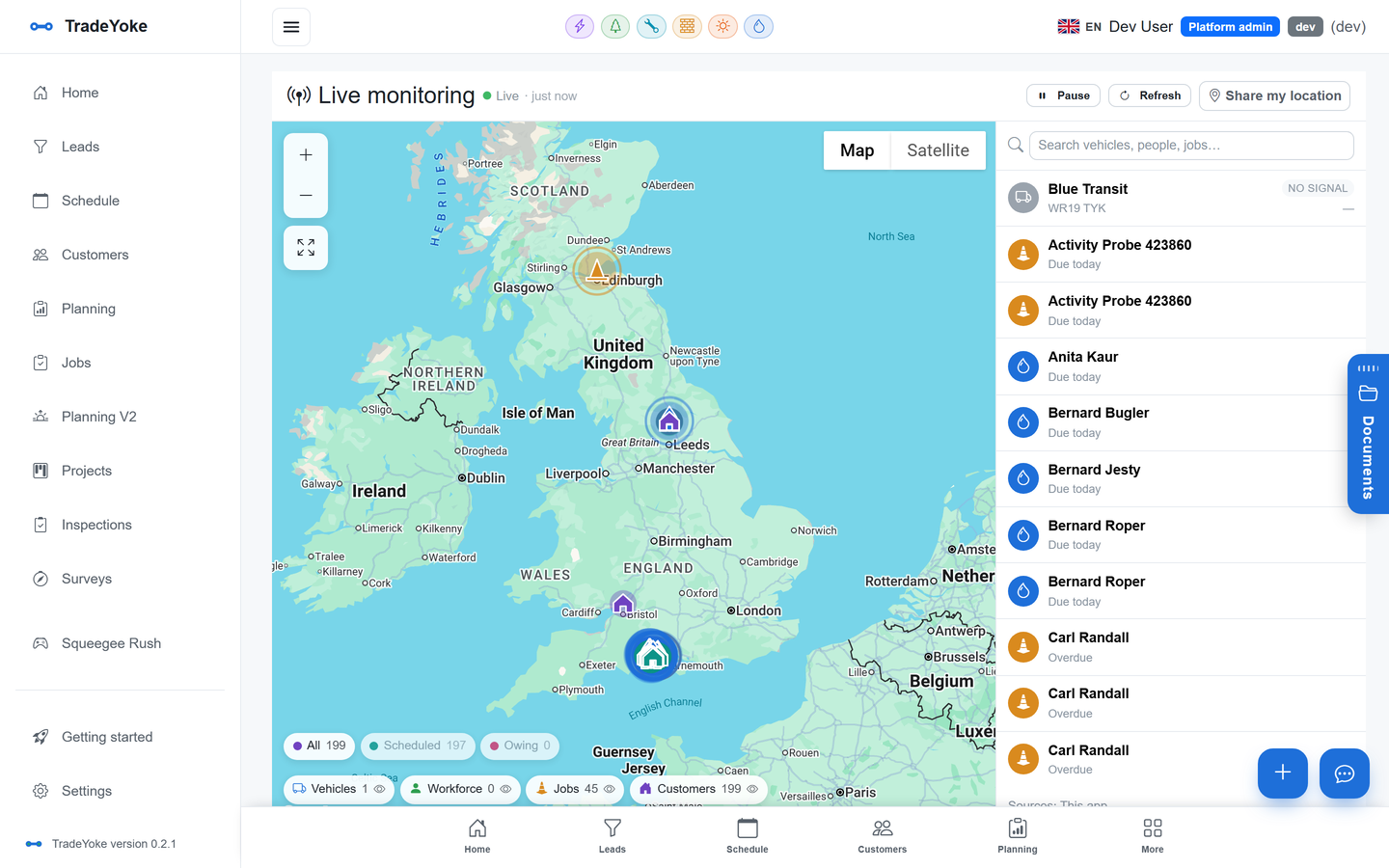
Quick answer: TradeYoke's live monitoring shows everyone sharing location on one map, with the phone itself as the tracker (no extra hardware), consent-gated per worker, alongside roles, permissions and an audit trail that keep the whole team accountable — it gives the office real visibility, not a monitored emergency-alarm service.
TradeYoke's Live monitoring (part of the Ultimate plan) turns the phone already in a scaffolder's or electrician's pocket into the tracker — there's no separate device to buy, charge or fit to a van. Each worker consents to sharing their location and can see exactly what's shared; the office sees everyone, today's jobs, customers and vehicles together on one map, with a trail that can be replayed if you need to check where someone was. It's honest about what it is: this is visibility for the office, not a certified, monitored panic-alarm service — for genuinely high-risk lone work, that's still a job for a dedicated BS 8484 device alongside it, not instead of it. Alongside it, TradeYoke's roles and permissions give every action an audit trail, so it's always clear who's assigned to which job and who did what, which matters as much for accountability as for safety.
Does TradeYoke replace a monitored lone-worker alarm device?
No. Live monitoring gives the office visibility of where the team is; a certified, monitored BS 8484 device with a 24/7 response centre is a different, more serious tool for genuinely high-risk lone work, and the two work well alongside each other rather than as substitutes.
Do I need to fit tracking hardware in the van?
No — the phone app itself is the tracker. Dedicated vehicle-tracking devices can be added through the same seam if you already have them.
Can a worker see they're being tracked?
Yes. Tracking is consent-gated per worker, and each person can see exactly what's being shared.
Which plan includes live monitoring?
Ultimate, TradeYoke's top plan — it also includes your own website and the customer portal. See /pricing for what every plan includes.
See where the team is, without new hardware
30 days of Essentials free, no card required. Live monitoring is part of the Ultimate plan — start a trial and see the map against a real day.